
Hygrometers
Thermohygrometers with Printable Data in Kenya
Across Kenya, there is a clear and growing shift in how temperature and humidity are monitored. Pharmacies, clinics, medical supply companies, and storage warehouses are no longer satisfied with simple digital displays. Instead, they are actively searching for thermohygrometers with printable data—devices that can record readings, export CSV files, and produce physical printouts for compliance and audits.
This surge in demand is driven by inspections, insurance requirements, supplier audits, and internal quality control policies. In this article, we explain why printable-data thermohygrometers are now essential, what buyers are looking for, and how models like ThermoPro TP358 and ThermoPro TP350 are being used across Kenya.
Why Printable Temperature & Humidity Data Matters
Temperature and humidity directly affect the safety and quality of:
- Medicines and vaccines
- Diagnostic kits and laboratory reagents
- Medical consumables and supplies
- Health-related imports stored in warehouses
Inspectors and auditors increasingly expect documented proof, not handwritten notes or verbal confirmation.
Common Problems with Non-Printable Devices
- Manual logs are easy to forget or manipulate
- No reliable historical record
- No proof during inspections or disputes
- Difficult to standardize across multiple locations
Thermohygrometers that export CSV files for printing solve all these issues by providing verifiable, timestamped records.
What Is a Thermohygrometer with Printable Data?
A printable-data thermohygrometer is a digital device that:
- Continuously logs temperature and humidity
- Stores historical readings
- Exports data in CSV format (Excel-compatible)
- Allows users to print reports for filing and audits
These devices are ideal for businesses that must maintain inspection-ready documentation at all times.
Why Demand Is Rising Rapidly in Kenya
Several trends are driving this demand:
- Increased pharmacy and clinic licensing inspections
- Growth of private healthcare facilities
- Expansion of medical importers and distributors
- Stricter warehouse quality standards
- Insurance and supplier compliance requirements
As a result, search terms like “thermohygrometer with printable data Kenya”, “CSV temperature humidity logger”, and “pharmacy temperature log printer” are becoming high-intent buyer keywords.
ThermoPro TP358: Professional Data Logging with CSV Export
The ThermoPro TP358 is designed for professional environments where traceable temperature and humidity records are required.
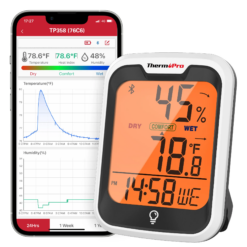
Why It’s Popular
- Accurate temperature & humidity monitoring
- Continuous data logging
- CSV export for printing and archiving
- Ideal for regulated environments
Use Case – Nairobi (Retail & Wholesale Pharmacies)
Pharmacies in Nairobi use TP358 units in drug storage rooms.
- Data is exported weekly as CSV
- Reports are printed and signed
- Files are kept ready for inspections
Result: Faster inspections and reduced compliance risk.
ThermoPro TP350: Simple, Reliable Printable Logs
The ThermoPro TP350 is a cost-effective option for facilities that need routine printable records without complex systems.


Why Buyers Choose It
- Stable long-term logging
- Clear digital display
- CSV export for easy printing
- Suitable for small to medium facilities
Use Case – Kisumu (Private Clinics & Labs)
A private clinic in Kisumu uses TP350 units to monitor medicine storage.
- Monthly CSV reports are printed
- Records are reviewed internally
- Compliance documentation is always available
Result: Consistent record-keeping with minimal effort.
Medical Warehouses & Importers
Use Case – Mombasa (Medical Supply Warehouses)
Coastal humidity poses a serious risk to stored medical products.
Warehouses in Mombasa rely on printable thermohygrometers to:
- Detect humidity spikes
- Print monthly condition reports
- Prove safe storage during audits
Result: Reduced spoilage and stronger supplier confidence.
Storage & Distribution Facilities
Use Case – Naivasha (Health Logistics & Distribution Centers)
Distribution hubs supporting clinics and NGOs use printable logs to:
- Attach temperature records to deliveries
- Maintain audit-ready files
- Meet donor and partner requirements
Result: Improved credibility and repeat contracts.
Why CSV Export Is More Important Than Mobile Apps Alone
While mobile apps are useful for monitoring, printed reports remain critical in many Kenyan inspections. CSV files allow businesses to:
- Print standardized reports
- Archive physical records
- Share data easily with inspectors
- Maintain long-term compliance history
This makes CSV export a decisive buying factor.
Who Should Use Thermohygrometers with Printable Data?
- Retail and wholesale pharmacies
- Clinics and hospitals
- Medical supply distributors
- Diagnostic laboratories
- Pharmaceutical warehouses
- NGO and donor-funded health projects
If your operation is inspected, audited, or insured, printable logs are no longer optional.
Final Thoughts: Printable Data Is the New Compliance Standard
Kenya’s healthcare and medical storage sector is evolving fast. Digital displays alone are no longer enough. Businesses must now prove that correct temperature and humidity conditions were maintained over time.
Thermohygrometers with CSV export and printable data, such as ThermoPro TP358 and ThermoPro TP350, provide:
- Audit-ready documentation
- Operational accountability
- Peace of mind during inspections
For pharmacies, clinics, and warehouses, these devices are not just monitoring tools—they are essential compliance equipment.

Pingback: hello world
Pingback: diflucan over the counter pill
Pingback: semaglutid bivirkninger
Pingback: ozempic coupon code
Pingback: cialis generic directions
Pingback: acyclovir cream for shingles treatment
Pingback: orlistat otc uk
Pingback: ketoconazole indication list
Pingback: ketorolac migraine relief
Pingback: ivermectin expert summary
Pingback: ivermectin rosacea anti‑demodex
Pingback: sildenafil Indian brand pricing
Pingback: vardenafil 20 mg dose reference
Pingback: vardenafil duration comparison
Pingback: insurance coverage pathway
Pingback: acute bronchitis